Beautiful might not be the right word to use every time I visit Lake Bunyonyi, Africa's second deepest Lake. Birhazia- free waters with undulating terraced hills sorounding this trough like lake.Perhaps the best relaxation place in Africa is a must see when you visit Uganda. It is also the best place in Africa to watch otters....you cant fail to see one!Nowonder the majority of tourists visit this wonderful place on their way from tracking the famous mountain gorillas of Bwindi National Park and Mgahinga. Bunyonyi literally means "many small birds" and indeed it is a place of many bird species. The cool breeze, green sorounding vegetation, clean water and sweet sounds from these birds make it purely natural and every time I see young children, old ladies and pregnant women canoeing to and from school, markets churches, plantation gardens on the numerous islands makes it more facinating! Lake Bunyonyi has attracted many investments in form of campsites, hotels and guest houses but still below capacity for the increasing number of tourists especially in the peak season and festive periods. I have never been in the best position to count the islands on this lake but 29 of them seems not to be the right figure! The people- the Bakiga always welcome you with that honest smile, perhaps the most hospitable tribe in Uganda I highly recommend Lake Bunyonyi to both Ugandan and foreign tourists.
The birth of twin in Buganda is treated as something special. Not only
are they always given special names, but the names of the parents are
also changed. When twins are born(It does not matter what sex they are)
the father change his name to salongo and the mother changes to Nalongo.
If the twins are boys they will be named Waswa and Kato while if they
are girls, they are Nakato and Babirye.
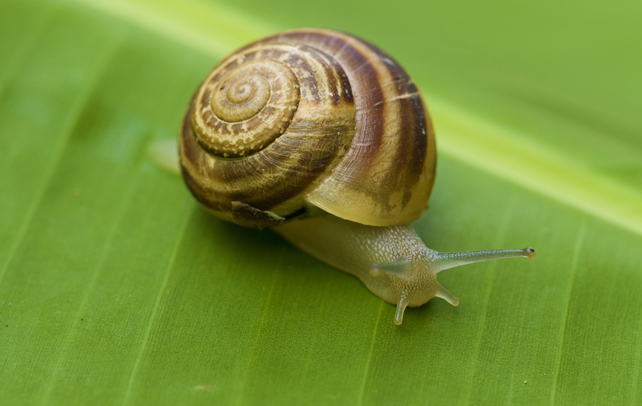
Snails include the kind served in
restaurants, as well as clams, and the snails in your garden that destroy your
plants.
They are triploblastic protostomes.
This means that their bodies are made up of a mass of material that holds the
organs, a foot that holds the muscle enabling them to attach to a surface, and
the head. Some, but not all, have eyes and tentacles.
The snail's body has a sheet or mantel, which forms a shell from secretions.
They scrape up their food by moving back and forth on an edible
surface. You can picture this when you recall seeing a snail attached to
a leaf. Later you see the leaf is full of holes.
snails do not have segmented bodies, like most all land animals.
They are believed to be related to the annelids. Annelids are animals
that do have segmented bodies.
They are not male or female - they are hermaphrodites. They can produce both
sperm and eggs.
The snail has no sense of hearing, they use their sense of smell and feeling
to maneuver about the earth. A snail is not in the insect family. There are more snails than
insects on earth.
The trail of slime that they leave as they move allows them to move on any
type of surface in any terrain without being injured. Think of being able to
walk on glass, sharp rocks etc. without hurting your feet.
Mature Nile crocodiles average 4 to 5 meters in length with exceptionally
large specimens reaching 6 meters. Large adults can weigh over 1000 kg and they can live for about 80-100 years.
Crocodiles are found in most game reserves throughout Africa, taking preference to rivers, lakes and wetlands.
Their
diet varies quite considerably depending on its age or size. Hatchings
prey mainly on insects, frogs, small fish and crabs. As they grow
larger they then start preying off larger fish like catfish as well as
birds.
Adults over 3 meters in length prey on birds, fish,
various antelope species, monitor lizards, snakes, other predators
including lions, leopards, hyenas, wild dogs as well as other
crocodiles.
Crocodiles are opportunistic predators and help clean water sources by feeding off any carrion they may find.Animals caught by crocodiles are normally dragged under water, causing
suffocation. Larger prey species, too large to be dragged under water
often die from a loss of blood and shock as a result of a number of
different crocodiles gripping and tearing off flesh at the same time.
When
feeding off large prey, the crocodile, using its powerful jaws and
gripping teeth, thrashes the prey around until small enough pieces to
swallow are torn off.
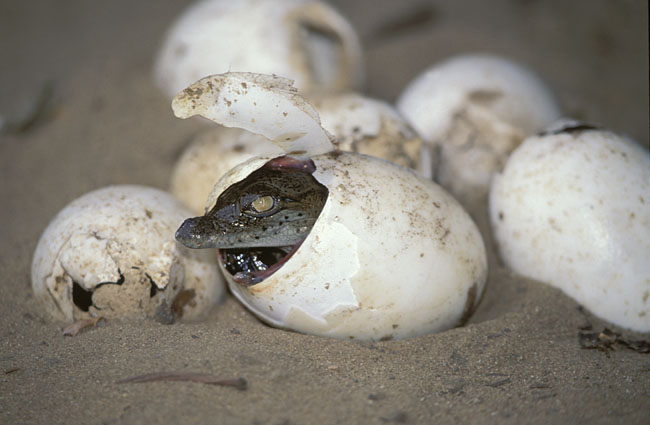
Crodile eggs being hatched
Crocodiles feeding on the same animal under
water grab hold of the prey with a tight grip and then spin their
bodies in order to break pieces of flesh off.
Nile crocodiles are sexually mature at about 12 – 14 years. Fertilization is internal with mating taking place in the water.
A mature giant crocodile
When the female is ready to lay eggs, she then looks for a suitable nest site with sufficient cover.
A
hole is excavated in a sand bank above the flood-line and after
depositing a clutch of between 20 and 80 eggs she then fills the hole up
with sand again.
The female is highly protective over her
nest and defends the eggs from being eaten by predators such as monitor
lizards, water mongoose, baboons and monkeys. During this period she
does not eat but will on occasion drink water.
The eggs incubate
for 3 months and on hatching the young make high-pitched cheeping
sounds, which attracts the mothers’ attention to the nest.
The female
then digs open the nest and using her jaws, she gently cracks open any
unhatched eggs, once done she then carefully carries the hatchlings in
her mouth to the river. The young crocodiles stay with their mother for
about 2 months before leaving on their own.
Any one spending some time in East Africa is likely to see a chameleon. In Uganda, the Baganda call them "Nawolovu" and most of them are terrified of these creatures and will not any amount of persuation touch them. The best known characteristics of the chameleon is perhaps is ability to change colour depending on its sorroundings but this is not only peculiarity. Is toungis long and warm llike can be suddenly extended for a distance greater than length of creatures own body. Insects, perticulary flies, which adhere to the sticky club shapped tip of the chameleon's toung are then drawn into its mouth. the eyes are set on prominent cones, whichh are covered with skin except fore the little pupil. Oppenings at the end. each eye moves indepently so that while one eye is seeing where the next foothold is , the other is looking arround for food. its momthe earth ooents are slow and deliberate, perhaps to help in the concelment that is attained by the change of colour to much the sorroundings.
The eggs of the chameleone are laid in the hole in the ground. The female digs the hole during the day.She uses her froont feet to collect up the earrth,which is then pushed under body towards the back limbs.When a small pile has collected under the middle of the animal the rare feet push the earth as far as back as they can reach.The process is continued until the hole reaches about seven ins deep a process that takes about sevven hours.The actual laying of eggs usually take place at night and the hole is then covered up again.
One of the myths that sorround the chameleone is that the female dies soon after giving birth.Onother popular myths is that if you a chameleone on a red surface it will burst both these are in fact untrue.
Gorillas are endangered animals where by half of the total population is only found in Uganda only in Bwindi impenetrable and Mgahinga Gorilla national parks. Majority of these magnificent primates are found in Bwindi impenetrable national park where by those one habituated in Mgahing occasionaly move the Volcanic Virunga mountains chain to neighbouring Rwanda and DR Congo. These heavily forested mountain regions have steep peaks and valleys covered with dense undergrowth and trecking the gorillas is arduous, dump but rewardind experince.
Gorillas are vigetarians spending most of there times eating shoots and leaves, living in families headed by a macure male giant called "silverback". The silver back starts hooting, drums his fists on chest, rears up, grimaces to to reveal two rows of fearsome teeth, screams and charges. By contrast, newborn gorillas are small, weighing about 2.5kk with are gestation period of similar to humans. Infants mortality rates are high with only young reaching maturity. Their estimate lifespan is thought to be about 25-30 years.
On visiting the Gorillas, first you are introduced to Ugandan tour Guide who explaines to you some of the rules of the park such as, no smorking, eating or drinking once you reach the gorillas,more so you are told what to do once you reach the silverback charging you, you are also told to stay still, crouch down and keep your heads down. You should at all times follow his instructions while him and the trackers keep on speak in gorilla language, to reassure the boss that you are freinds not foes.
The first part of the walk is the easiest,Along the sunlight path decorated by scores of dancing butterflies, as you continue to move, you move through valleys, bush and here you find some spots marked with nests and branches and leaves where gorillas had spent a previouse night and huge dung. fron here, the truckers hack the thick bush following the traills of the Gorillas. As you continue when closse to them, the trucker stops you, have drinks and snacks as your last point. After the rest, you continue as the conditions and atmosphere changes realising that you are closse to them. within few miute, You hear a loud grunt and you realise that you are near them.
The Guide startes to reply the Gorillas, making deep coughing noise, and you slowly crept around, keeping a fair distance to the grunting.
At the end you see them feeding unconcerned on your presence and this is always a group headed by a silver back which is always big as everything on him is big than you imagin
It is in the mouth or buccal cavity where food is tone, cut and nibbled
& grind to smaller particles before being swallowed.
The soft part of the mouth or buccal cavity is also well supplied with
relatively small mucus gland which helps to moistly and lubricate the food be4
swallowing.
Oesophagus It is more less a muscular tube which convey the flood from the mouth to the
crop. Its size depends on the type of food eaten.
It is also provided mucus glands which affords the food to pass smoothly from
the mouth to crop.
The crop In many birds, the posterior end of the oesophagus becomes enlarged into a
storage chamber known as a crop. Here, food is stored until a stomach can
accommodate.
In pigeons, the crop is very dev’d and it is here that “pigeon milk” is
secreted to feed the young. Pigeon milk is a large substance rich in fats and
proteins. The substance is mixed with food in the crop and then regurgitated
into the mouth of the young bird. Crops are generally prominent in grain eaters
like game birds and pigeons.
They permit the owner to gather and swallow food in a hurry way, thus
shortening their exposure to their enemies.
The same thing is true with the ruminates where the rumen is the food
storage chamber. The difference between crop and rumen is that; in the crop the
food is not regurgitated back in the mouth fore recuing and reswallowing. Crop
also permits hard seeds to be softened with mucus be4 further digestion in the
stomach and intestines. No digestive gland is known exist in the walls of the
crop.
Stomach The stomach of bird is divided into two distinct functional organs. There
is the interior soft and glandular stomach also known as proventiculus and
repostilier. Muscular stomach known as the gizzard
PROVENTRICULUS OR GLANDULAR STOMACH.
This is an organ which evolved after the evolution of birds. It is not found
in reptiles. The stomach is well supplied with peptic enzymes that digest protein
foods. The secretion is also highly acidic and therefore able to desolve large
bones. The proventiculusare glandular stomach is more developed among meet esters
that plant and seed eaters.
THE GIZZARD OR MOSCULAR STOMACH
It is a Rotarian trait. I.e. it is also found in reptiles. The gizzard is
some time known as the “grinding stone”. It normally posses grits or small
stones (swallowed by birds) which helps to crush or digest seeds and other plant
materials and as would be expected the gizzard is more dev’d amongst seed and
plant eater that meat eaters.
The following are figures which show considerable force generated by a
compressive walls of gizzard as formed in different birds. Force is expressed
in millimeters of mercury.
Hen has 100-150mm
Ducks has 180mm
Goose has 265-280mm
Turkey has been known to grind 12 steel niddles to pieces in 36hrs and 16
surgical linnets to pieces in 16 hrs.
A huge of sheet iron that could be only bent under a load of 36kg was
flattened and partly rolled within 24hrs.
The gizzard is also found amongst carnivorous birds spp but here its
function seems to act as a troupe that prevent sharp bones and undigestable
things from proceeding down in digestive system such resist them may be rolled
up into elongated pellet and rig agitated by mouth.
THE LIVER The liver of a bird is a to logged structure. It is the largest gland in the
body and it is larger in birds than in mammals of comparable size and is also
somewhat in lager in fish and insect eater than in meat and grain eaters.
Basically the liver in birds has the same function as in mammals such
function are;
To store excess sugar
To manufacture bile
To synthesis certain proteins from amino acids
To excrete waste products
Stores vitamins and minerals
Dicrofy poison
Supplies quick energy to the body and by using sugar into the body
As regards the secretion of water products from the blood it is
worthy to note that 60% of the uric acid, which is achieved nitrogenous pdts of
birds, is found in the liver and excreted in kidney.
Together with other waste products, the kidneys pass on uric acid to the
cloaca to final digestion outer the body.
PANCREAS like the liver, pancreas is larger in birds tan in mammals of comparable
size. It’s also larger among fish, insects and grain eaters than meat eaters.
The 1 degree function of pancreas is to produce or secrete digestive enzymes
which act on all three types of food like fats, Cabohydrates and protein.
INTESTINE it is chief organ of digestion and absorption of food. In birds, the organ
is not sharply differentiated into regions as in mammals.
A reptilian x-tic in intestines of birds is longitudinal muscle found on
the outside walls of the intestines as opposed to mammals whose intestinal
longitudinal muscles are found inside the walls of the intestines.
Among related spp, large birds are required to absorb more nutrients in
order to survive and a longer intestine provides the necessary required volume
for digestion and absorption of food. Doubling linear dimension of an object
increases the volume by 8 times. Relatively the smaller intestines are found in
grain eaters than in other birds. This is because grain eaters take more solid
food and therefore need more space for its digestion and absorption.
CAECA The main function is absorption water and digested proteins, and particular
the bacterial decomposition of crude fibrous. The undigested matter in the
caeca is dark and moist and is discharged separately in a whitish dinner
intestinal feeces. In domestic hen there is one caeca discharge for a bit a very
intestinal defecation.
CLOACA A cavity in birds & reptiles in w/c the intestinal & urinary ducts
in terminate. The cloaca is found at the end of the intestinal canal & its
divided in2 3 regions.
·Coprodacum Interior regions w/c
receives excrements in the intestines.
·Urodacum Middle region w/c
receives discharges of the kidney through the ureters and of the gentle organs
through the vas deferens/oviduct.
·Proctolaeum Posterior or
terminal regions and is suplied with powerful ejection muscles. It’s closed
posterior by the muscular anus. Its main function is to store the excrements
before final discharge.
ADAPTION OF BIRDS FOR FLIGHT
In order 2 conquer the air, birds have evolved features adapted 4 flight.
The adaptations are not confined 2 birds a lone but also 2 bats, flying
squirrels etc. however when it comes 2 sustained flying, birds are considered
true flyers.
Features adapted 4 flight
Uniformity in body size plus architecture. In general birds have a union
body size i.e. the difference btn the smallest the smallest the largest bird is
considerably smaller than the difference btn the smallest & largest
mammals. Example of body size uniformity.
Spp
wf/1
Ratio (largest Vs smallest)
Ostrich
144kg
{ 1:64.000}
Humming birds
2225g {
1:64.000}
Blue whale
190000kg
{1:82600000}
Plggmy shrew
2.3g
{1:82600000}
Weight reducing adaptation Compared the reptiles & mammals, bones, of
birds are much higher. Some of the weight decreasing adaptation are as follows.
Skeleton Greatly reduced in weight compared 2 mammals or reptiles of comparable size
e.g. the skeleton and all other bones of a 7kg pelican weighs 0.6kg or 9.3% of
the total body weight of the bird.
A pigeon’s skeleton accounts for 4.4% body weight whereas compared to a
rat, the skeleton accounts 4 5.6% of the total body weight. It reduced long
tail 2 4m stunted pygostyle.
·Bird’s hand (wings) finger bones are decreased
both in size and No’s where by fingers are missing plus 2 of the remaining 3
fingers are fused.
·Absence of teeth
·Sternum is thin & keeled there by greatly
decreased in weight.
·Bones of birds are hollow hence greatly reduced
the heavier.
Light feathers: presence of feathers has replaced the heavier
scale and scutes found in reptiles.
Air sacs presence of air sacs which are branched all throughout the body&
penetrating the hallow bones. The air sacs and the feathers are responsible for
reducing the specific gravity of flying birds. The specific gravity of
feathered duck is 0.6 compared 21.0in most vertebrates.
Excretory system Absence of urinary bladder & urethra 2 hold
and discharge urine. The kidney exploit nitrogenous waste concentrated in 4m of
uric acid w/c passes directly through the cloaca whose walls further absorb
more H2O. The wastes pass 2gether with those of the intestines in
the form of conc white guano.
Reproductive system Birds don’t give birth to live young ones and not
carry to unborn baby inside the body. Female spp of birds don’t contain one
function ovary and oviduct (the left). The right ovary is normally atrophical
and doesn’t develop for reproduction. Eggs are laid outside and the development
of young occurs outside the body of the mother. Both ovaries and tests are
atrophy during non breeding season. It has been found that sex organs of
starlings weigh about 1500 times more during the breeding season compared 2 the
non breeding season.
Body glands Except uropygial gland (oil gland), Glands are generally absent in birds.
 Beautiful might not be the right word to use every time I visit Lake Bunyonyi, Africa's second deepest Lake.
 Birhazia- free waters with undulating terraced hills sorounding this trough like lake.Perhaps the best relaxation place in Africa is a must see when you visit Uganda. It is also the best place in Africa to watch otters....you cant fail to see one!Nowonder the majority of tourists visit this wonderful place on their way from tracking the famous mountain gorillas of Bwindi National Park and Mgahinga. Bunyonyi literally means "many small birds" and indeed it is a place of many bird species. The cool breeze, green sorounding vegetation, clean water and sweet sounds from these birds make it purely natural and every time I see young children, old ladies and pregnant women canoeing to and from school, markets churches, plantation gardens on the numerous islands makes it more facinating! Lake Bunyonyi has attracted many investments in form of campsites, hotels and guest houses but still below capacity for the increasing number of tourists especially in the peak season and festive periods. I have never been in the best position to count the islands on this lake but 29 of them seems not to be the right figure! The people- the Bakiga always welcome you with that honest smile, perhaps the most hospitable tribe in Uganda I highly recommend Lake Bunyonyi to both Ugandan and foreign tourists.